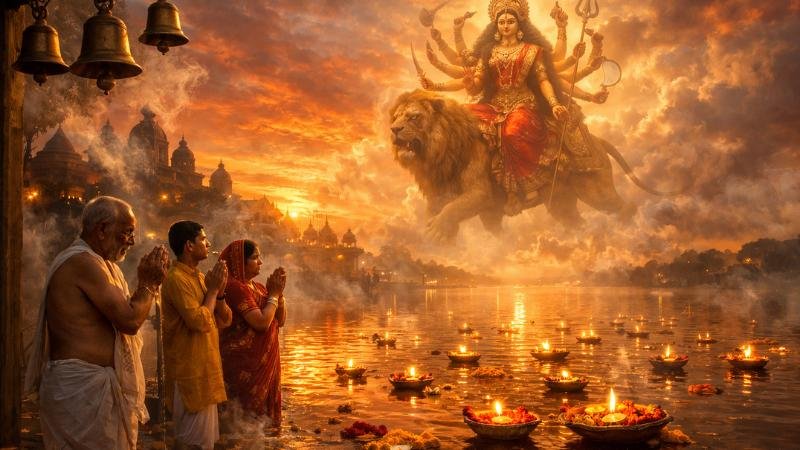

If Maa Shailaputri teaches us to begin, Maa Brahmacharini to persevere, Maa Chandraghanta to act with courage, Maa Kushmanda to create, Maa Skandamata to nurture, Maa Katyayani to stand for what is right, and Maa Kalaratri to face our fears, then Maa Mahagauri invites us to move towards purity, peace, forgiveness, and spiritual renewal.
Worshipped on the eighth day of Navratri, Maa Mahagauri is a serene and compassionate manifestation of the Divine Mother. Her name means the supremely radiant or exceptionally fair one. Her traditional imagery, characterised by white garments and a luminous appearance, symbolises purity, tranquillity and the removal of suffering.
Through the symbolic lens of numerology, her qualities can be explored alongside Number 8 — karma, responsibility, resilience, justice and transformation through experience.
The connection between Maa Mahagauri and Number 8 is an interpretive spiritual association inspired by the eighth day of Navratri.
1. Why connect Maa Mahagauri with Number 8?

Purification after life’s challenges
Number 8 is often interpreted through the themes of responsibility, consequences and lessons learned through experience. Maa Mahagauri’s symbolism invites us to reflect on how difficult experiences can lead to greater awareness, humility and inner clarity.

Strength softened by serenity
Number 8 is frequently associated with endurance, authority and material responsibility. Maa Mahagauri reminds us that true strength need not be harsh; it can be expressed through calmness, fairness and self-mastery.

The opportunity to begin again
Her luminous form symbolises purity and renewal. In a numerological reflection, this suggests that past mistakes need not define our future when we accept responsibility and choose a wiser path.
2. Maa Mahagauri and the deeper psychology of Number 8
In Chaldean numerology, Number 8 is traditionally associated with Saturn, known in Indian astrology as Shani. Saturn symbolises discipline, accountability, patience, justice and the consequences of our actions.
Number 8 is often portrayed as a number of significant life lessons. Its journey may involve learning to use power responsibly, balancing material ambition with inner values, and developing strength without becoming hardened by experience.
Maa Mahagauri’s symbolism offers a beautiful spiritual counterbalance: the ability to remain pure in intention even while navigating life’s difficult lessons.
Number 8 — The Achiever
Karma • Discipline • Justice • Resilience
Number 8 represents the challenge of balancing worldly responsibility with personal integrity and inner development.
Lessons we can draw from Maa Mahagauri
- Purify your intentions: Examine not only what you do, but why you do it.
- Accept responsibility: Acknowledge mistakes without allowing guilt to become your identity.
- Use power ethically: Success is most meaningful when it does not come at the cost of another person’s dignity.
- Practise forgiveness: Release resentment where possible while maintaining healthy boundaries.
- Seek inner peace: Do not allow the pursuit of achievement to consume your entire sense of self.
3. The deeper symbolism of Maa Mahagauri


Her white garments — purity and clarity
White is a central feature of Maa Mahagauri’s traditional iconography. It symbolises purity, serenity and spiritual clarity. For Number 8, this imagery invites us to pursue achievement without compromising our values.
The white bull — strength with steadiness
Her traditional mount represents strength and stability. It reminds us that real resilience is not merely the ability to endure hardship but the ability to move through it without losing our sense of direction.
The trident — discernment and the overcoming of obstacles
The trident is a symbol of divine power. As a reflective metaphor, it invites us to examine the patterns that keep us stuck and make choices that support a more conscious life.
Her serene expression — peace after struggle
Maa Mahagauri’s calm appearance offers a powerful contrast to the fierce form of Maa Kalaratri, worshipped on the preceding day. Symbolically, the movement from the seventh day to the eighth can represent the journey from confronting darkness to finding clarity and peace.
4. Maa Mahagauri and the shadow side of Number 8
In numerological interpretation, Number 8 can be associated with excessive control, overwork, fear of failure or becoming overly identified with material success.
Maa Mahagauri’s symbolism encourages a gentler relationship with responsibility, achievement and the past.
| Potential challenge | Spiritual lesson |
|---|---|
| Carrying old guilt | Accept the lesson and choose a better path |
| Becoming too controlling | Practise trust alongside responsibility |
| Measuring worth through success | Recognise your value beyond achievements |
| Holding on to resentment | Work towards forgiveness without abandoning boundaries |
| Feeling hardened by hardship | Preserve compassion while remaining strong |
These are reflection prompts, not inevitable characteristics of everyone associated with Number 8.
5. The karmic significance: Can we begin again?
One of the most meaningful connections between Maa Mahagauri and Number 8 involves the idea of accountability without permanent self-condemnation.
In spiritual traditions, karma concerns actions and their consequences. Numerology sometimes uses the language of karmic lessons to explore responsibility and personal development, although numerology is not a scientifically established way to determine someone’s karmic destiny.
Maa Mahagauri’s symbolism invites us to reflect on three important principles:
- Recognise: Acknowledge the choices and patterns that have contributed to your present circumstances.
- Repair: Where possible, make amends and take practical steps to correct what went wrong.
- Renew: Move forward with greater wisdom instead of repeatedly punishing yourself for the past.
This is particularly relevant to the symbolic journey of Number 8, where responsibility can be understood not as punishment, but as an opportunity to develop maturity and integrity.
6. A spiritual practice inspired by Maa Mahagauri

Begin with prayer
Offer your prayers to Maa Mahagauri. You may chant Om Devi Mahagauryai Namah with devotion and a calm mind.

Reflect honestly.
Ask yourself: What am I carrying that I could begin to release — guilt, resentment, an outdated belief or an unrealistic expectation?

Choose renewal.
Identify one action that will bring greater clarity into your life. It may be making amends, simplifying a commitment, forgiving yourself or establishing a healthier boundary.
7. An affirmation inspired by Maa Mahagauri
My affirmation
“With the blessings of Maa Mahagauri, I release what no longer serves my growth. I accept my responsibilities with courage, learn from my experiences and choose integrity in my actions. I welcome clarity, practise forgiveness and allow peace to grow within me. My strength is grounded in wisdom, and my success is guided by compassion.”
The deeper message: From karmic lessons to inner peace
The first eight days of Navratri can be explored as a symbolic journey of personal evolution:
- Maa Shailaputri — Day 1: Establish your foundation.
- Maa Brahmacharini — Day 2: Cultivate discipline.
- Maa Chandraghanta — Day 3: Develop courage.
- Maa Kushmanda — Day 4: Awaken creativity.
- Maa Skandamata — Day 5: Nurture growth.
- Maa Katyayani — Day 6: Stand for what is right.
- Maa Kalaratri — Day 7: Face fear and embrace transformation.
- Maa Mahagauri — Day 8: Seek purity, forgiveness and renewal.
Through this interpretive numerological journey, Number 8 brings us to a profound question: after everything life has taught us, what kind of person are we choosing to become?
Maa Mahagauri reminds us that the purpose of life’s lessons is not to leave us burdened forever. We can learn, take responsibility, release what is harmful and move forward with greater awareness.
The message for Number 8 is this: true strength is not merely the ability to withstand life’s hardships. It is the ability to emerge from them without losing your integrity, compassion or inner peace.