
History and Mythology behind Gudi Padwa
Gudi Padwa (also spelt Gudhi Padwa or Gudi Padvo) is the traditional Marathi and Konkani Hindu New Year, celebrated on Chaitra Shukla Pratipada—the first day of the bright lunar fortnight in the month of Chaitra (typically March–April in the Gregorian calendar). It marks the onset of spring, the harvest of rabi crops, and the beginning of the lunisolar Hindu calendar year for communities in Maharashtra, Goa, and surrounding regions. Similar festivals observed elsewhere include Ugadi (in Karnataka, Andhra Pradesh, and Telangana), Cheti Chand (among Sindhis), and others, reflecting shared South Asian lunisolar traditions.
Etymology
The name derives from two parts:
- Gudi (or Gudhi) refers to a decorated flag or banner, a term of South Indian origin according to linguist Ferdinand Kittel.
- Padwa (or Padvo/Padvo) comes from the Sanskrit pratipad (or pratipada), denoting the first day of each lunar fortnight—specifically the day after the new moon (amāvāsya).
This etymology ties directly to the central ritual of hoisting a gudi as a symbol of victory and renewal.
Mythological Origins (Backed by Traditional Texts)
Gudi Padwa’s mythology draws from ancient Hindu scriptures, particularly Puranas and epics. These accounts, while legendary rather than empirical history, form the cultural and scriptural foundation cited consistently across traditional sources.
- Lord Brahma’s Creation of the Universe
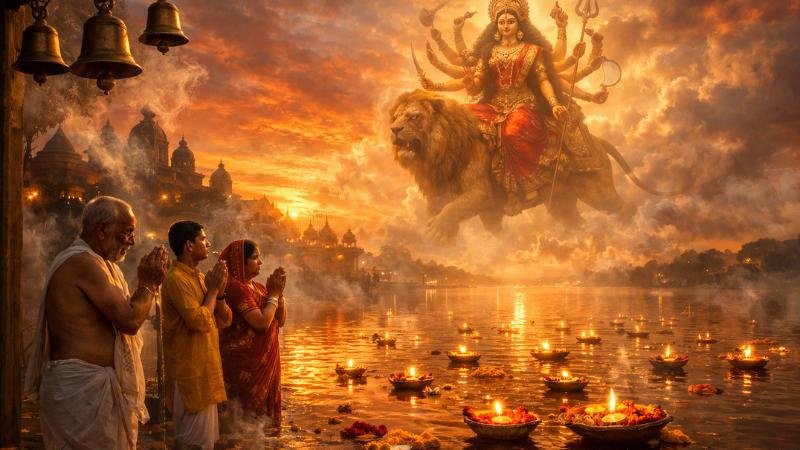
According to the Brahma Purana (one of the oldest Puranas), a cosmic deluge (Pralaya) once destroyed all life and halted time. On this day (Chaitra Pratipada), Lord Brahma—the creator deity—recreated the universe, restarted the wheel of time (Kalachakra), and initiated the Satyuga (Age of Truth and Justice). The gudi itself is described as symbolizing Brahma’s flag (Brahma-dhvaj), or in some interpretations, Indra’s flag, representing the triumph of order over chaos. This legend is explicitly referenced in the Brahma Purana and echoed in cultural retellings. It positions Gudi Padwa as the literal “beginning of time” in the Hindu cosmological cycle. - Lord Rama’s Victory and Coronation
Drawing from the Ramayana epic, the festival commemorates Rama’s return to Ayodhya after 14 years of exile and his victory over Ravana. Upon his triumphant homecoming and coronation as king, the people of Ayodhya hoisted victory flags (with inverted pots) to celebrate dharma’s win over adharma. The modern gudi replicates this—hoisted at household entrances—to invoke the same spirit of righteousness, prosperity, and the return of good times. This narrative links the festival explicitly to Rama’s story and is widely accepted in Marathi and broader Hindu traditions. - King Shalivahana’s Triumph and the Shalivahana Era
As per the Bhavishya Purana (and popular tradition), legendary king Shalivahana (of the Satavahana dynasty, 1st–2nd century CE) defeated invading Sakas (or Huns in variant accounts). Upon his victorious return to Paithan (Pratishthana), his subjects raised gudis in celebration. This event is mythologically credited with starting the Shalivahana Shaka calendar era (which began historically around 78 CE and is still used in parts of India alongside the Vikram Samvat). The gudi here symbolizes national or royal victory and the dawn of a new epoch. Some accounts also loosely connect it to Vishnu’s Matsya avatar, though that connection is less central.
These Puranic and epic references (Brahma Purana, Bhavishya Purana, and Ramayana) provide the primary scriptural backing. Scholars of Hindu mythology, such as those synthesizing folk and textual traditions, treat them as foundational to the festival’s pan-Indian spring New Year observances.
Historical Development and Regional Context
While the mythological core is ancient, the festival’s observance as a prominent regional celebration evolved through historical periods:
- Ancient and Medieval Roots (Yadava Era): Cultural historians trace its origins as a harvest festival to the Yadava dynasty (12th–14th centuries) in the Deccan region of Maharashtra. It marked the end of one agricultural cycle and the start of the next, aligning with the spring equinox and rabi crop reaping. This practical agrarian significance predates its stronger royal associations.
- The festival became popular again during the Maratha Empire Era (17th Century) under Chhatrapati Shivaji Maharaj, who started the Maratha Empire. He is credited with using it to commemorate military victories and promote unity, peace, and prosperity among his subjects. Traditions of hoisting victory flags (gudis) in homes and public spaces are popularly linked to this period, blending the mythological victory symbols with historical Maratha pride. Some accounts suggest Shivaji formalised or popularised certain customs, though primary historical documents emphasise their pre-existing cultural role.
- Scholarly Observations: Anthropologist Anne Feldhaus has noted rural Maharashtrian practices where gudis connect to Shiva temples and community processions (e.g., carrying gudhi kavads), highlighting folk-Shaivite layers alongside the Brahminical and royal narratives. The festival’s spread aligns with the Marathi diaspora and Konkani communities.
Modern celebrations retain these layers: homes are cleaned, rangolis drawn, gudis raised (with specific symbolic elements—neem for health/balance, mango leaves for purity, inverted kalash for prosperity), and a bitter-sweet neem-jaggery dish eaten to symbolize life’s experiences. It remains a civic and cultural holiday in Maharashtra, distinct from other Hindu New Years (e.g., Gujarat’s Diwali-timed Bestu Varas or North India’s Vikram Samvat emphasis).
In summary, Gudi Padwa’s mythology is firmly rooted in Puranic accounts of cosmic creation (Brahma), epic victory (Rama), and legendary kingship (Shalivahana), while its history reflects an ancient harvest rite amplified through mediaeval dynasties and Maratha cultural revival. These elements, corroborated across scriptural texts, ethnographic studies, and consistent regional traditions, explain its enduring role as a festival of renewal, victory, and springtime hope. Sources such as the Brahma Purana and Bhavishya Purana, alongside scholarly syntheses like Wikipedia’s referenced overview, provide the research foundation for these narratives.